
Kushinagar
As the sun rises over Kushinagar's tranquil landscape, a sense of serenity settles over the city, drawing seekers of spiritual enlightenment and cultural enthusiasts alike. This sacred town in Uttar Pradesh's heartland is a magnet for pilgrims and history buffs, who come to pay homage to the Buddha's final days and explore the rich tapestry of Indian heritage. The air is thick with the whispers of ancient wisdom, as visitors wander through the lush green surroundings, tracing the footsteps of the Enlightened One and immersing themselves in the city's storied past.
Why Kushinagar is famous
- •Three names, three eras: One source gives KUSHAVATI in the pre-Buddha period, KUSINARA in the Buddha's time, and KUSHINAGAR after. It was the capital of the MALLAS, one of the sixteen mahajanapadas of the 6th century BCE.
- •Its inscription: A 5th-century inscription at the centre states the statue was 'a gift of the monk HARIBALA to the Mahavihara and that it was fashioned by DINNA'. One source adds that it bears the 32 MARKS OF THE GREAT MAN.
AI-drafted from general knowledge — may contain mistakes.
History at a glance
- 6th century BCEKusinara is the capital of the Mallas, one of the sixteen mahajanapadas.
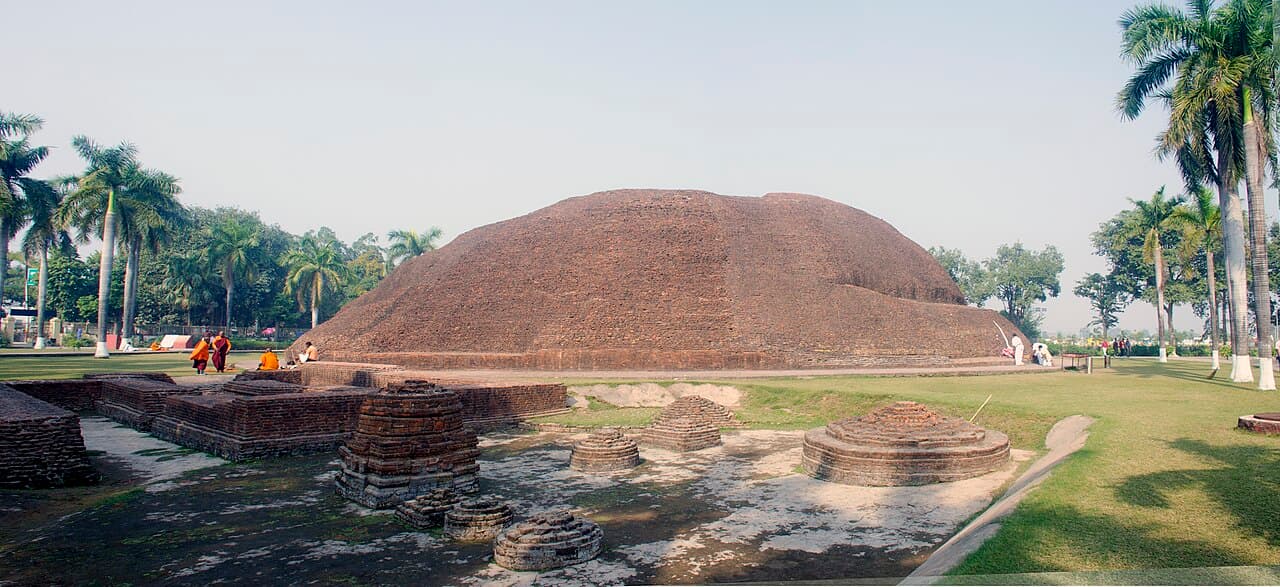
- 487 BCEThe Buddha, ill after forty-five years of teaching, reaches Kushinagar, ordains his last disciple, speaks his final words to the sangha and attains parinirvana. The Mallas raise a stupa over his relics and a second mound at the cremation site.
- 3rd century BCEAshoka renovates both the Parinirvana Stupa and the Ramabhar cremation mound, and builds at the site.
- 5th century CEThe reclining Buddha is carved from a single block of Mathura red sandstone. Its inscription names it a gift of the monk Haribala, fashioned by Dinna. Gupta rulers expand the Nirvana stupa and the site.
- AD 637Xuanzang sees the colossal Nirvana Buddha at Kusinagara and documents the Ashokan renovation.
- c. 1200 CEBuddhist monks abandon the site fleeing an invading army. It degrades and is eventually lost under mounds.
- 14th centuryThe temple is illustrated in the Jami' al-tawarikh.
- 1876-77A.C.L. Carlleyle exposes the Mahaparinirvana stupa and discovers the reclining statue buried beneath a mound, broken into numberless fragments. It is entirely reconstructed and restored in March 1877.
- 1901 or 1903The Burmese monk Sayadaw U Chandramani applies to the English Governor for permission to let pilgrims worship the reclining Buddha — making it a living place of worship again.
- 1910Excavation of the main stupa reveals copper coins of Jai Gupta, a copper vessel with a copper plate, and a vessel of silver coins of Kumar Gupta.
- 1927The stupa structure is last renovated before the modern rebuild.
- 1942The Chandramani Free School is founded. One source says it runs to this day.
- 1956The Indian Government builds the present temple for the 2,500th year of the Mahaparinirvana. The temple and stupa assume their present form.
Best time to visit
- In 3 daysDiwali · 8 November
- In 5 daysGovardhan Puja · 10 November
- In 6 daysBhai Dooj · 11 November
- In 10 daysChhath Puja · 15 November
Real dates, not AI-drafted — sourced from the Hindu Panchang, same for every destination.
Part of these sacred circuits
Near me
Share your location to see famous places closest to you right now.
Famous places in Kushinagar
Sacred & Spiritual
See all 19 →Heritage & Monuments
Nature & Outdoors
Shops & Restaurants
Places to Stay
Civic & Services
Getting there & around
- Air — KUSHINAGAR INTERNATIONAL AIRPORT (KBK) provides direct international access. One source advises 60 minutes for security normally, 90 on peak charter days, and 90-120 minutes total for international Buddhist charter flights. Gorakhpur airport is given as 53 km by the district and about 40 km by another source
- Rail — Deoria Sadar railway station at about 35 km. E-rickshaws and autos handle the town.
What travellers actually paid
Reported by real travellers, not looked up — a real range with a count, never a single guessed number.
Loading…
Local businesses
View all →A different trust signal from the curated places above — some run by their real owner, some pre-filled by Swamarg from its own place data until an owner claims them.