
Konark
Wheels, sculptures, and intricate carvings
The sound of waves and chanting fills the salty air
Konark, also spelt Konarak. From Sanskrit kona, corner or angle, and arka, the sun - both its dedication and its position at the corner of the land. Also Arka Kshetra and Surya Devalaya. Called the Black Pagoda by European sailors..
Konark is known for
Why Konark is famous
- •Setting: On the Odisha coast, about 35 km north-east of Puri and roughly 65 km from Bhubaneswar airport. A small town with no direct air or rail connection of its own.
- •Status: UNESCO World Heritage Site, inscribed 1984. An ASI-protected monument with no deity and no daily worship.
- •Why it matters for the product: Ninth destination, and the second that is not a city. Khajuraho is a town that exists for a monument; Konark is a monument that has lost its town, its tower, its deity and its sea. The entire product here is interpretation, and most of what there is to interpret is absent.
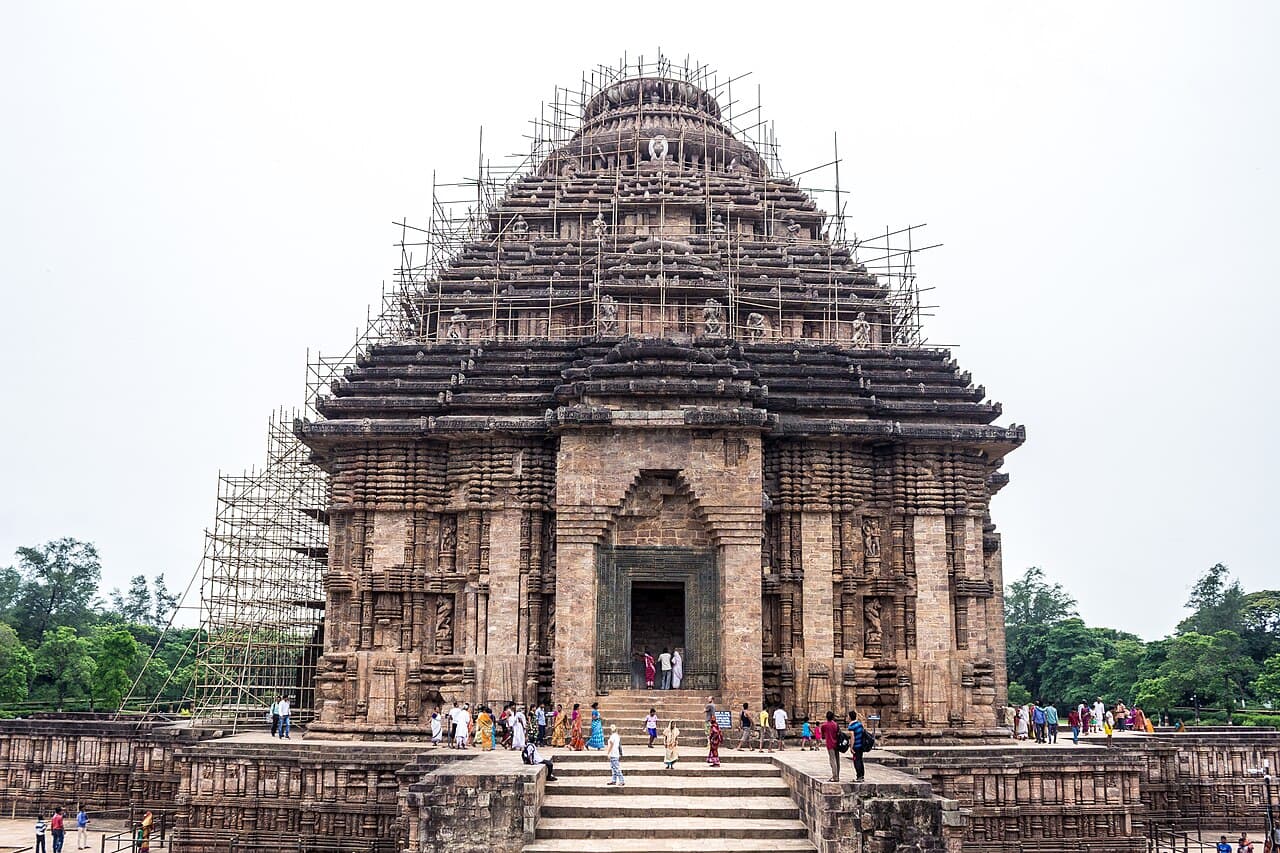
- •What it is: A temple conceived as the colossal stone chariot of Surya, set on twenty-four carved wheels - twelve pairs - each about three metres across, drawn by stone horses. UNESCO calls it the culmination of Kalingan temple architecture, with all its defining elements in complete and perfect form.
- •How many horses: UNESCO's own page says 'a team of six horses' in the brief description and 'seven horses' in the Outstanding Universal Value statement. Almost every other source says seven. A live contradiction inside a single UNESCO page, exactly as at Khajuraho with the temple count.
- •What is missing: The main deul, reported at about 229 feet, has collapsed. What stands is the jagamohana, reported at about 128 feet. The temple was in use for roughly three centuries.
- •When and why it fell: Genuinely unresolved. Dates given include the late 16th century, the early 17th, and the 1830s. Causes proposed include subsidence of the foundation, earthquake, lightning, cyclone and Portuguese damage - and some scholars doubt the tower was ever completed. Mitra summarises the dispute; do not resolve it.
- •The sealed hall: The ASI packed the jagamohana's interior with sand and stone in 1903 to prevent further collapse. It stabilised the structure and permanently sealed the interior, which remains inaccessible.
- •The wheels work: The twenty-four wheels function as sundials. The hour can still be read from them by shadow. This is the single best thing a guide can demonstrate at Konark and almost nothing else in India offers it.
- •What is carved: Deities, surasundaris, musicians, dancers, lovers, courtly life, war scenes, fantastic lions, and symbolic motifs referring to the cycle of the seasons and the months. UNESCO describes it as embellished with sophisticated and refined depictions of contemporary life and activities. The Nata Mandapa carries dance-themed sculpture in particular.
- •The erotic sculpture: Konark is described as having the highest concentration of erotic sculpture of any Hindu temple in India - a stronger claim than Khajuraho, where it is under a tenth of the carving. The erotic figures are reported at eye level in the middle band and in larger form in the upper layer. UNESCO's own text notes erotic groups among the plinth reliefs and links the temple to Brahmanical and tantric belief systems.
- •The explanations offered: SCHOLARLY: UNESCO ties the imagery to Brahmanical and tantric belief systems. TRADITIONAL: readings of maithuna as symbolic union, as at Khajuraho. POPULAR: the Kamasutra attribution, which specialists on Khajuraho have questioned and which should be handled with the same caution here. REFUTED: the explanation guides sometimes give, that the carvings were meant to encourage reproduction after the Kalinga war depopulated the region - the Kalinga war was around 262 BCE and the temple around 1250 CE, fifteen centuries apart. Record that one and mark it false.
- •It is not a working temple: There is no deity in the sanctum and no daily puja. In the Dharmapada tradition, a death within the temple precinct rendered the site unfit for consecration and the Aruna Stambha intended for it was never installed there.
- •But pilgrimage continues: Magha Saptami, the Chandrabhaga Mela in February, draws thousands to bathe at the pool and then watch the sun rise over the sea from the beach, followed by puja of the Navagraha. Worship moved outdoors when the building stopped working.
- •The Aruna Stambha: The pillar intended for Konark now stands at the Lion Gate of the Jagannath Temple in Puri, where it remains. One monument's missing component is another's landmark, 35 km away.
- •Golden Triangle of Odisha: Konark, Puri and Bhubaneswar are treated as one itinerary and are almost never visited separately. Puri is already a destination in your dataset.
- •Best season and time: October to March. Sunrise above all - the temple faces east and was built to catch the first light off the sea. Open sunrise to sunset; ticketed by the ASI.
- •Where to stay: Most visitors stay at Puri. Konark itself is quieter and less crowded, and is known locally for seafood - a rare case where the smaller option is the better recommendation.
- •Guidance: As at Khajuraho, the site is not readable unaided. There is an ASI museum, an interpretation centre and an evening sound-and-light show. A guide is worth it, particularly for the sundial demonstration.
AI-drafted from general knowledge — may contain mistakes.
History at a glance
- Puranic · LEGENDARYSamba, son of Krishna, is held in tradition to have been cured of leprosy by worshipping Surya at this coast. A sacred pond near the beach carries the association.
- 1238-1264 · EASTERN GANGAReign of Narasimhadeva I, who commissions the temple around 1250. Several accounts read it as a statement of imperial Surya worship marking military victories.
- c. 1250 · EASTERN GANGAConstruction begins. Accounts give about twelve years of work and around 1,200 artisans.
- 13th century · EASTERN GANGAThe temple is completed - or, on one line of scholarly argument, never fully completed.
- 16th century · MUGHALAbul Fazl records the temple's effect on visitors, writing that even those difficult to please stand astonished at the sight.
- Late 16th to 19th century · DECLINEThe main deul collapses. The date is given variously as the late 16th century, the early 17th, and the 1830s. The cause is unresolved: subsidence, earthquake, lightning, cyclone, Portuguese damage, or never completed.
- Colonial period · COLONIALEuropean sailors use the temple as a navigation landmark and call it the Black Pagoda.
- 1903 · COLONIALThe ASI packs the interior of the surviving jagamohana with sand and stone to stabilise it. The hall is preserved and permanently sealed.
- 1984 · MODERNThe Sun Temple, Konarak is inscribed on the UNESCO World Heritage List.
- Modern · MODERNThe Konark Dance Festival is established in the open-air auditorium near the temple, bringing Odissi, Bharatanatyam, Manipuri, Kathak and Chhau performers together annually.
Best time to visit
Konark, being a coastal city in Odisha, experiences a tropical climate with hot and humid summers, and mild winters. The monsoon season typically brings heavy rainfall from June to September, with the rest of the year being dry and sunny.
- Magha Saptami (Chandrabhaga Mela) · anchored to Magha Shukla SaptamiThousands bathe in the pond, then move to the beach to watch the sun rise over the sea in a custom the Puranas describe, followed by puja of the Navagraha. This is where Konark's worship actually happens - the temple itself has no deity. (Lunar - compute from the Panchang)
- Konark Dance Festival · anchored to Annual, fixed by the organisersOdissi, Bharatanatyam, Manipuri, Kathak and Chhau performed beside the temple whose Nata Mandapa is covered in dance sculpture. (Verify the dates with Odisha Tourism; Khajuraho's festival month was also reported inconsistently)
- Sound and light show · anchored to Daily, after dark[SCHEDULED SPECTACLE] An evening presentation at the site. (Verify it is running and its timings)
- Sunrise · anchored to Daily[DAILY - BY DESIGN] Not an event, but the condition the building was designed for: a Surya temple facing east on the shore, built to take the first light. Treating sunrise as the intended visit rather than merely the prettiest one is the difference between describing the monument and understanding it.
- In 12 daysGandhi Jayanti · 2 October
- In 29 daysDurga Ashtami / Maha Navami · 19 October
- In 30 daysDussehra (Vijayadashami) · 20 October
- In 39 daysKarwa Chauth · 29 October
Real dates, not AI-drafted — sourced from the Hindu Panchang, same for every destination.
Weather details and any festival without a stated lunar anchor above are AI-drafted from general knowledge, not independently verified — timing is approximate; double-check before planning around one.
Part of these sacred circuits
Near me
Share your location to see famous places closest to you right now.
Famous places in Konark
Sacred & Spiritual
Heritage & Monuments
See all 13 →Nature & Outdoors
Getting there & around
- Air — No airport or railway station of its own. Bhubaneswar airport is about 65 km
- Getting around — Puri is about 35 km along the marine drive, which runs through the Balukhand sanctuary.
What travellers actually paid
Reported by real travellers, not looked up — a real range with a count, never a single guessed number.
Loading…